No mental math
Just mark the procedure as done — the app recalculates the next step and shows a safe timer status.
Your schedule, analytics, and data — all in one system
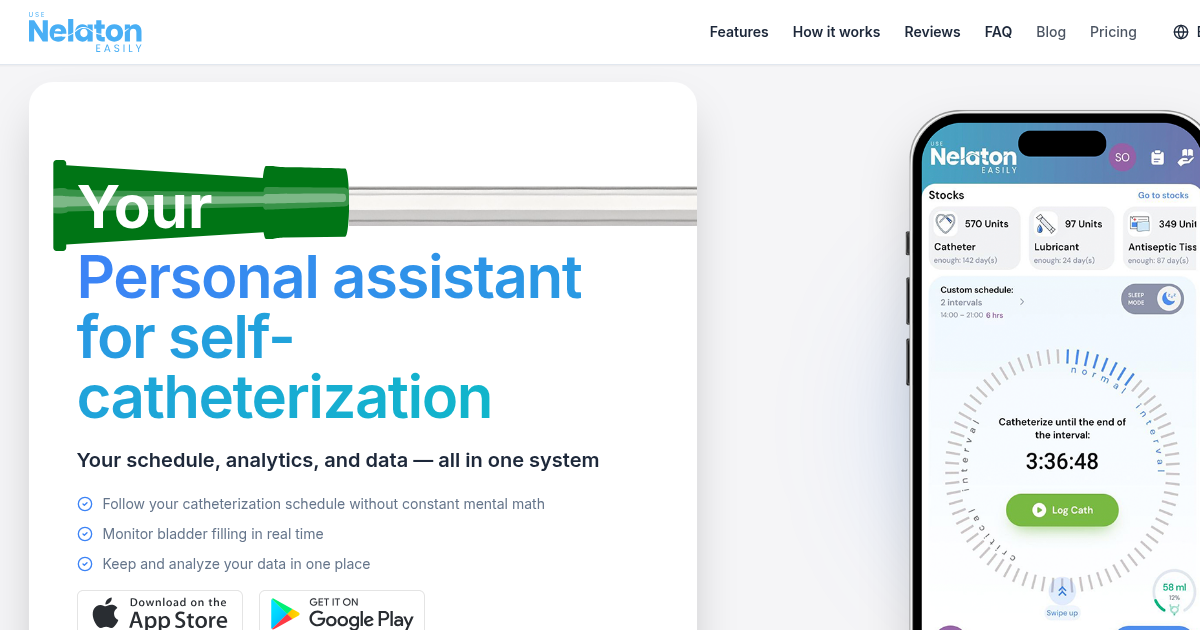
Nelaton helps you avoid missing self-catheterization, shows the risk of bladder overfilling, and collects data for your doctor.
Just mark the procedure as done — the app recalculates the next step and shows a safe timer status.
Smart Bladder shows estimated filling in ml and %, so you do not have to rely only on the clock.
Diary, PDF, analysis, and doctor sharing — everything in one system.
Intermittent self-catheterization mimics the natural emptying of the bladder. To protect your health, it is important to keep the right interval between procedures and monitor the volume of urine being drained.
4–6 hours. According to international medical guidance, catheterization should be performed every 4–6 hours. It is essential in the morning right after waking up and in the evening just before going to sleep.
400–500 ml. The main goal of the schedule is to make sure that no more than 400–500 ml of urine is drained during each catheterization. This helps protect the bladder from overstretching and the kidneys from complications.
The app helps you track the right time for the procedure without difficult mental calculations. The system tells you when it is time to catheterize, helping reduce the risk of bladder overfilling and urine leakage.
This kind of routine helps maintain a safe bladder volume and lowers the risk of complications.
See how each feature helps you manage self-catheterization with confidence.
You always know when you can wait, when it is already time, and when catheterization can no longer be delayed. It automatically calculates the time of the next procedure, sends notifications, shows status by color, and adapts if you catheterize earlier or later.
Predicts the volume of urine in your bladder in real time. You see the risk of overfilling before the timer goes off.
Your whole day at a glance: completed, missed, and upcoming procedures in one timeline.
A structured diary that helps you track every key aspect of self-catheterization: catheterization, natural voiding, drinks, leakage, spasms, symptoms, and other important data.
Highlights risks and deviations in your diary — not instead of your doctor, but to support the conversation with your doctor. Fast evaluation of your diary, regularity, volumes, fluid balance, and symptoms.
Automatic stock deduction, forecast in days, and a travel calculator. Your catheters will not run out unexpectedly.
Secure online access to catheterization data for your doctor, parent, or caregiver. Share structured diary data instead of screenshots.
Nelaton brings together 5 safety layers that strengthen one another and make the routine more predictable.
So catheterization happens on time.
So you can see the risk of overfilling in real time.
So your supplies do not run out unexpectedly.
So you can quickly notice deviations and discuss them with your doctor.
So your data stays transparent, protected, and accessible in one click.
Less anxiety. More of the feeling that “I am in control.” Nelaton helps you catheterize regularly and safely.
You can see that the procedure has been completed even when you are not nearby. Easy Share gives you secure access to real-time data.
Collects the key data needed to assess the current condition.
The app adapted to my needs very quickly — basically, it just asked me a few questions and handled the rest on its own. Honestly, it is incredibly convenient and really makes life easier.
When I was told I would need to catheterize my bladder regularly, I was terrified. But I am so glad I found this app — it helped me calm down and feel like I was in control.
At the hospital, they told me to keep a bladder diary and even gave me a stack of paper forms. Doing it in the app is much easier and far more convenient.
The timer counts down to your next catheterization. You need to catheterize before the timer runs out in order to stay on the schedule set by your doctor. If you miss a scheduled catheterization, the timer will show how much time has passed since your last one. After each catheterization, open the app and tap the “Done” button to start the countdown to the next catheterization.
How often you need to catheterize is determined by your doctor based on your condition. It is also important to note that the frequency may change over time. We help you easily track your voiding habits, which helps your doctor adjust the interval between catheterizations when needed. In general, self-catheterization should be performed regularly throughout the day, depending on how much fluid you drink and your doctor’s recommendations. You may need to catheterize every 4–6 hours to keep the bladder volume below 400 ml. If you do not catheterize often enough and your bladder becomes overfilled, the risk of urinary tract infections and urinary leakage increases. Long-term overstretching of the bladder can lead to serious kidney damage.
Adults should drink at least 1.5 liters of water per day. This is only a general recommendation, and you should speak with your doctor to find out how much water is right for you. Remember that water is the best drink. It is recommended to avoid beverages containing caffeine because caffeine can irritate the bladder. Drinking enough water helps flush the urinary system. The Nelaton app helps you track your hydration level. You can log water intake on the home screen using the “+Drank” button, and on the “Water Balance” screen you can monitor both fluid intake and urine output.
Practice good hygiene, empty your bladder regularly and completely, and drink enough fluids. We recommend completing our catheterization satisfaction questionnaire at least once a month and sharing it with your doctor.
Usually, it is enough to catheterize before bed and again immediately after waking up, then continue at regular intervals during the day. However, your doctor will advise you on what is best for you. The app helps you follow any catheterization schedule and interval. You can set up nighttime catheterization, follow an interval overnight, or even disable nighttime catheterization by turning on sleep mode. It all depends on your doctor’s recommendations, and our app is ready to help you follow any schedule.
The app automatically tracks catheter use. You need to specify how many catheters you have and whether you use extra supplies during catheterization, such as aseptic wipes, urine bags, gloves, and more. This helps you keep track of how many catheters and essential supplies you have and restock on time. Every time you tap the “Done” button, the app deducts the corresponding amount of supplies. When you buy catheters or other consumables, do not forget to update the quantity in the app.
Take enough catheters with you and carry a medical certificate confirming that you need them. This certificate can help you get through airport security or other high-security checkpoints. In the “Catheter Use” tab, you can calculate how many catheters to take with you based on your average usage.
Write to us using the form on this page. Describe the situation you encountered and which feature you believe is missing from the Nelaton app. We will review your suggestions in future updates.